Reddit marketing works when a real person with a visible history answers real questions in the right communities, follows each community's rules, says who they work for, and keeps at it long enough for the threads to be read. This guide covers the whole process in order: foundations, research, the account, writing comments and posts, disclosure, hostile threads, moderators, working with a team, tools, measurement, a worked example, and a troubleshooting table.
This is the long version. For a short definition, read what Reddit marketing is. For the planning view, read the Reddit marketing strategy.
Key takeaways
- Treat Reddit as many small communities, each with its own rules and moderators. Learn one before you write anything in it.
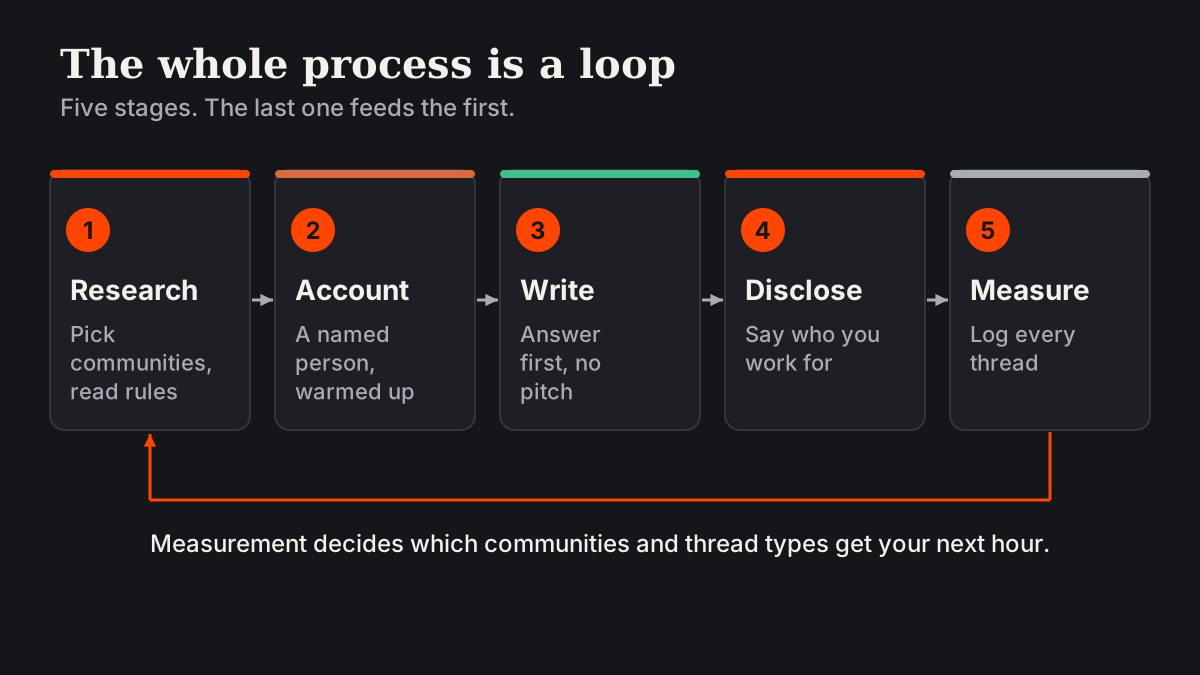
- The work runs in a loop: research, account, write, disclose, measure, then back to research. Most people who fail skipped the first two steps.
- A good comment answers first and shows its reasoning. It adds one specific detail, states a limit, and discloses your affiliation if the product comes up.
- A promotional comment has to stand on its own. If it's useless once you delete your product from it, it's an ad.
- Downvotes and removals tell you something. Read the reason, fix what you can, and don't argue in public.
- Measure each thread with a simple log and four levels of outcome. Add branded search and an open "how did you hear about us" field. Expect most of the demand to show up indirectly.
Foundations
Reddit is made of subreddits, each run by volunteer moderators who write the rules and remove posts that break them. Votes and age decide what gets seen, and a growing share of readers arrive from search without an account. In Q1 2026, Reddit reported 74.8 million logged-out daily users against 52.0 million logged-in. The mechanics are in what Reddit marketing is, and the vocabulary (OP, flair, AMA) is in the slang glossary.
The rest of this guide rests on three ideas.
First, each community decides. There is no single "Reddit self-promotion rule". r/SaaS limits self-promotion to once per 60 days and counts comment plugs and alt accounts as the same user. Other communities ban it outright or confine it to a weekly thread. The question to keep asking is "what does this community allow", not "what does Reddit allow".
Second, you are a member first. Reddit's site-wide Rule 2 asks people to participate authentically in communities where they have a personal interest. A commenter in an r/b2bmarketing thread gave the practical version: "Reddit is phenomenal for lead gen as long as you can provide value upfront. Don't spam and just share as much insight as you can about the subjects you are an expert in." (thread).
Third, the payoff is slow and uneven. Nobody publishes a reliable benchmark, and one B2B commenter wrote "I did a campaign and it underperformed Facebook and LinkedIn". Plan on weeks before any return, and expect some products not to fit.
Finding the threads and subreddits
Most of good Reddit marketing comes down to picking the right places. Spend your first week reading.
Find your starting community
Start from one place where people already discuss your category. Search your product category, your competitors' names and the problem you solve, both on Reddit and in Google with site:reddit.com. The subreddit with the most active, relevant discussion is your seed. If nothing comes up for your product, back up to the underlying problem. How to find your target subreddit walks through the method with a worked example, and the free subreddit finder automates the expansion step.
Then score the candidates. The strategy page has a five-criteria scoring method with a worked example: buyer fit, intent density, search visibility, rules tolerance and engagement depth. Score eight to twelve communities and keep three to five.
Read like a researcher
Read each shortlisted community for at least a week before you write anything. Open the rules, the wiki and the pinned posts. Then sort by top for the last month, check the new feed, and answer these questions in a notes file:
- What questions come up most often, and in what words?
- Which answers get upvoted: short and direct, or long and detailed? Do they include links?
- What gets removed? Moderator comments in threads tell you a lot here.
- Who are the regulars and moderators? Note usernames so you can tell a stranger from a regular.
- Does a brand or vendor ever get a good reception, and how do they phrase it?
Find the threads that matter
Two kinds of thread deserve your time.
The first is threads that rank in search. Search site:reddit.com plus the phrases a buyer would type: "best [category] for [use]", "[competitor] alternatives", "[competitor] vs". Write down the threads on page one and their dates. Some old threads no longer accept new comments, so check before you plan around one. Our guide to finding keywords where Reddit ranks describes two ways to build the list.
The second is fresh threads where someone is asking. Use saved searches, keyword alerts and the new and rising feeds. The free thread finder and keyword alerts cover this at no cost. A keyword match is not a buyer, though. People who use monitoring tools say an alert only tells you someone typed a phrase, which is why you need both intent scoring and a human reading the thread (see Reddit lead generation tools and intent).
Keep a research log
A spreadsheet with one row per community and one per thread is enough. For communities, record the name, a rules summary (what vendors are allowed to do), account-age and karma gates if you know them, typical question types and the score. For threads, record the URL, date, whether it ranks, what was asked, whether you answered, a link to your comment and the outcome. You'll use the same sheet for measurement later in this guide.
The account and profile
Whose account
Use a real, named person's account when you take part in other people's communities. Founders, product leads and support engineers work well because they know the subject. Keep the brand account for announcements and your own subreddit. Reddit's rules for businesses say to be transparent about which brand you represent and not to claim your account belongs to a consumer user. Our brand vs personal account post covers the options and what happened to teams that tried each one.
One practitioner who runs a brand account described what worked for them in r/RedditforBusiness. They "reached out to the mods of each subreddit" first and answered without links, adding: "Eventually if someone requested a link from me specifically I would offer it, but only then." (thread). That's one account's experience, but it's a good model if you want to start conservatively.
The profile
- A display name that matches who you are.
- A short bio with your role and company ("works on X at Y").
- No link to your landing page during warm-up.
- A history that isn't only about your product, with comments in more than one topic.
Warm-up
Reddit doesn't publish a number of days. Many subreddits gate posting on account age and karma, and most keep the thresholds private. Reddit also tracks a hidden Contributor Quality Score that moderators and filters can use.
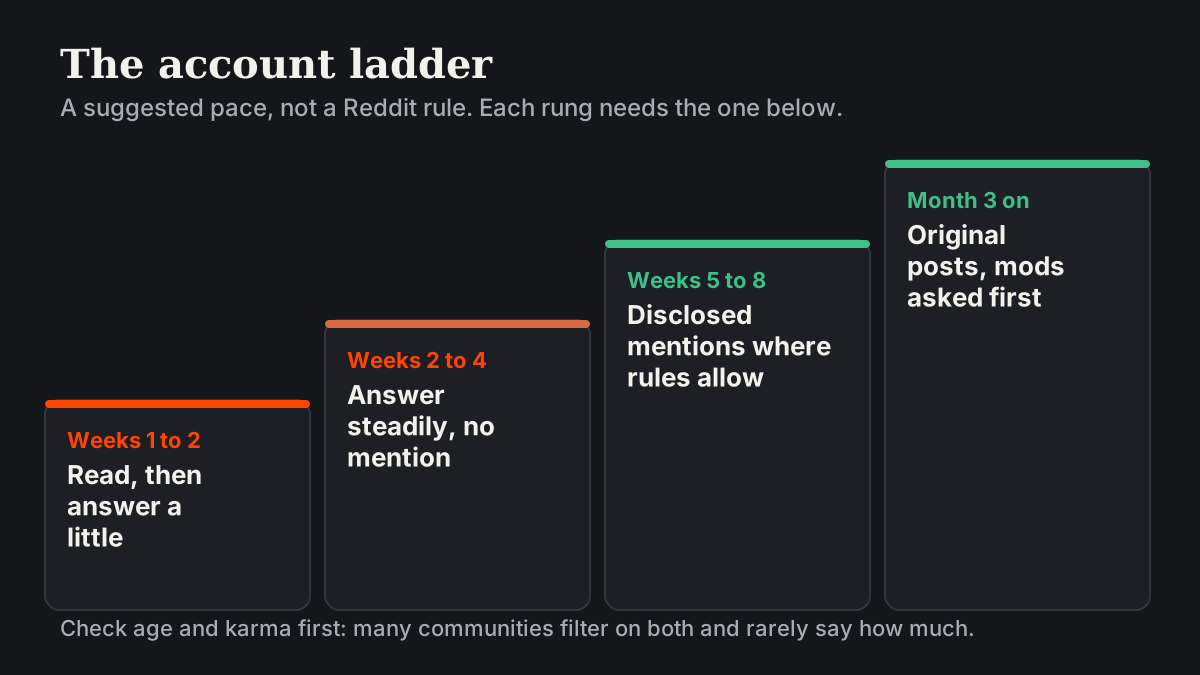
Here's a reasonable ladder. It's our suggestion, not a Reddit rule:
- Weeks 1 to 2: read, and answer a little. Join your shortlist and write a few useful comments on questions you know.
- Weeks 2 to 4: answer steadily without mentioning your product. Three or four thoughtful comments a day beat twenty low-effort ones. Spread them across the communities.
- Weeks 5 to 8: disclosed mentions where the rules allow, and only in threads that ask for options.
- Month 3 onward: original posts, once the community knows your name and after you've checked the rules or asked the mods.
Track progress with the free account lookup, and read the warm-up guide and karma guide for details. Don't buy karma, accounts or upvotes. The User Agreement says you will not "license, sell, or transfer your Account" without Reddit's written approval. See what happens when people try.
Writing comments and posts that survive
The anatomy of a comment that holds up
A comment survives when it helps the reader, sounds like a person wrote it, and would still be fine if the product vanished. Here is the shape, with each part labelled.
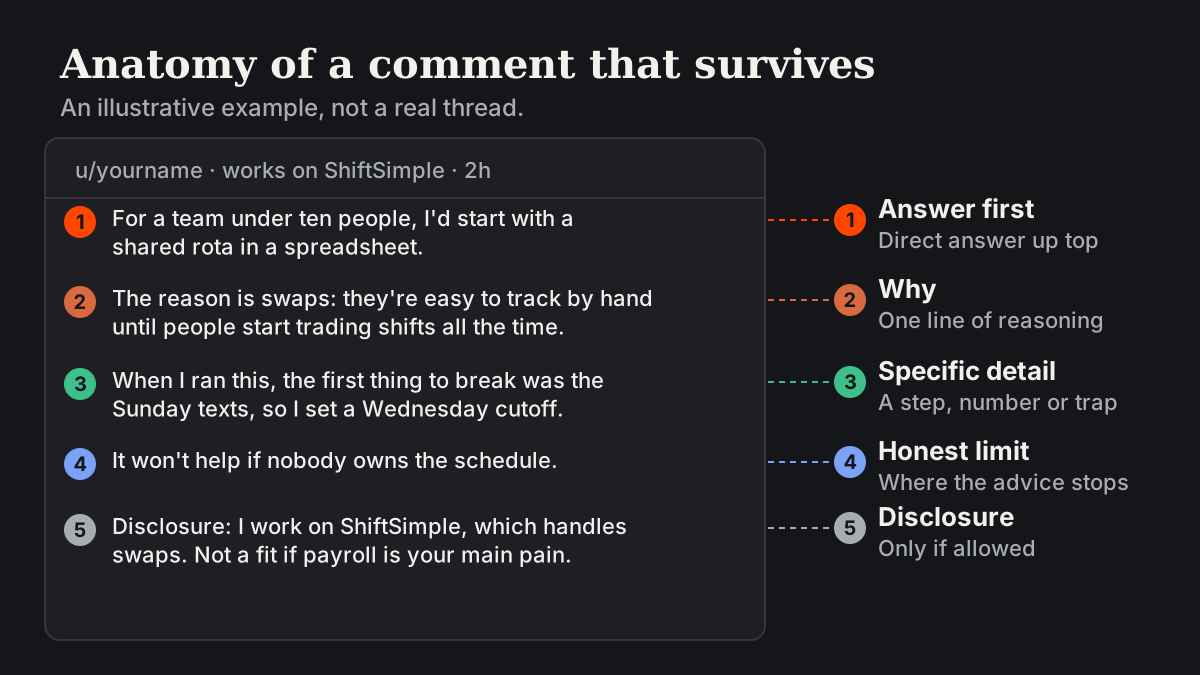
- Answer first. The reader sees the direct answer before anything else.
- Give the why in one or two sentences of reasoning.
- Add a specific detail: a step, a number you can stand behind, a trap you fell into.
- Say where the advice stops working, or where a competitor is better.
- Disclose, then point if you need to. If you mention your product, say you work on it and stop there.
Use the words people in that community use. Keep paragraphs short and skip headings and bullet lists unless the community uses them. Drop corporate phrases and marketing adjectives. Don't paste an unedited AI draft. It reads as generic, and some communities have rules against AI-generated text.
Copyable templates
These are skeletons, not scripts. Replace everything in brackets with something specific, or don't post.
Template 1 answers a "how do I" question, with no mention of your product:
The short answer: [direct answer in one sentence]. The reason is [one line of reasoning]. When I [did the thing], [specific result or trap]. Where this breaks: [limit or exception]. If you tell me [missing detail], I can be more specific.
Template 2 answers a "what do you use for X" request:
I've used [option A] and [option B]. [Option A] is better for [case] because [reason]. [Option B] is better for [other case], but [real drawback]. Full disclosure, I work on [your product], which does [narrow thing]. It's a poor fit if [honest limit], so I'd check [alternative] first in that case.
Template 3 replies to a challenge:
Fair point, [what they got right]. I should have [clarified/said]. What I meant was [one clear sentence]. If that doesn't match your experience, I'd like to hear what you're seeing.
Template 4 is an original question post:
Title: [Specific question in the community's own words] Body: What I'm trying to do: [one paragraph]. What I've tried: [two or three things]. What I'm unsure about: [one question]. I work on [product] in this area, so I'm biased on [topic]. Happy to share what I learn.
Template 5 is an original "what I learned" post:
Title: [What happened, plainly] Body: [Context in two sentences]. [What we did]. [What happened, with real numbers only if they are yours]. [What we'd do differently]. [Question to the community].
Check each template against the rules before you use it. Our free post rule checker reads the subreddit's current rules against your draft.
Titles, formatting and timing
The title is the whole pitch for a post, so make it descriptive and honest and use the community's own phrasing. "What made you switch away from [category] tool?" reads as a question because it is one. "We built X" reads as an ad. Pick the post type the subreddit allows (text, link, image) and add flair if it's required. Reddit has no native scheduling, so write and post in the same session. Post when the community's audience is awake, which may not be your time zone. The first hour after posting matters more than the hour of day you pick, as the algorithm guide explains. For the button-by-button mechanics, see how to post on Reddit.
Self-promotion and disclosure
What counts as promotion
In most communities, promotion covers any mention of your product, any link to your site and any content you produced, free or not. Moderators make the call, and their reading counts for more than your intent. Common triggers: links in comments from new accounts, links to your own free content, posts from a corporate handle, the same message repeated across communities, and a first post about your product.
The delete test
The ratio people quote, nine helpful contributions for every promotional one, is a rough guide. What moderators check is whether each promotional comment would still be useful with the product line removed. Our 9:1 rule guide breaks down what counts on each side. In practice: write the comment, delete every sentence that mentions your product, and read what's left. If that doesn't answer the question, don't post it.
How to disclose
- Say it once, plainly, near the mention: "I work on X" or "I'm the founder of X".
- Say who it isn't for.
- If you built it, don't call it "a tool I found".
- If a community requires a specific disclosure format, use theirs.
Reddit also has a Brand Affiliate tag for posts and comments with commercial intent, and it notes that you're still responsible for any disclosure the law requires. Its rules for businesses also say not to give users incentives to say positive things about your product.
Where promotion is allowed
Check the sidebar for weekly self-promotion threads, special flair or an explicit allowance. Rules vary a lot between communities and change often, so check the live rules before every post. How to promote on Reddit without getting banned compares the rules of seven communities as we read them on 1 November 2026.
Never astroturf
Don't create accounts that pose as customers, don't ask friends to upvote, and don't use multiple accounts to vote or to reply to yourself. Reddit's policy covers vote manipulation and coordinated activity, and a June 2026 teardown of Reddit's anti-spam systems describes account fingerprinting by ISP, email domain and TLS signature. We explain what astroturfing looks like and how it gets caught in why we do not astroturf.
Handling downvotes and hostile threads
Not every response will be friendly, especially if you are a vendor in a skeptical community.
What a downvote tells you
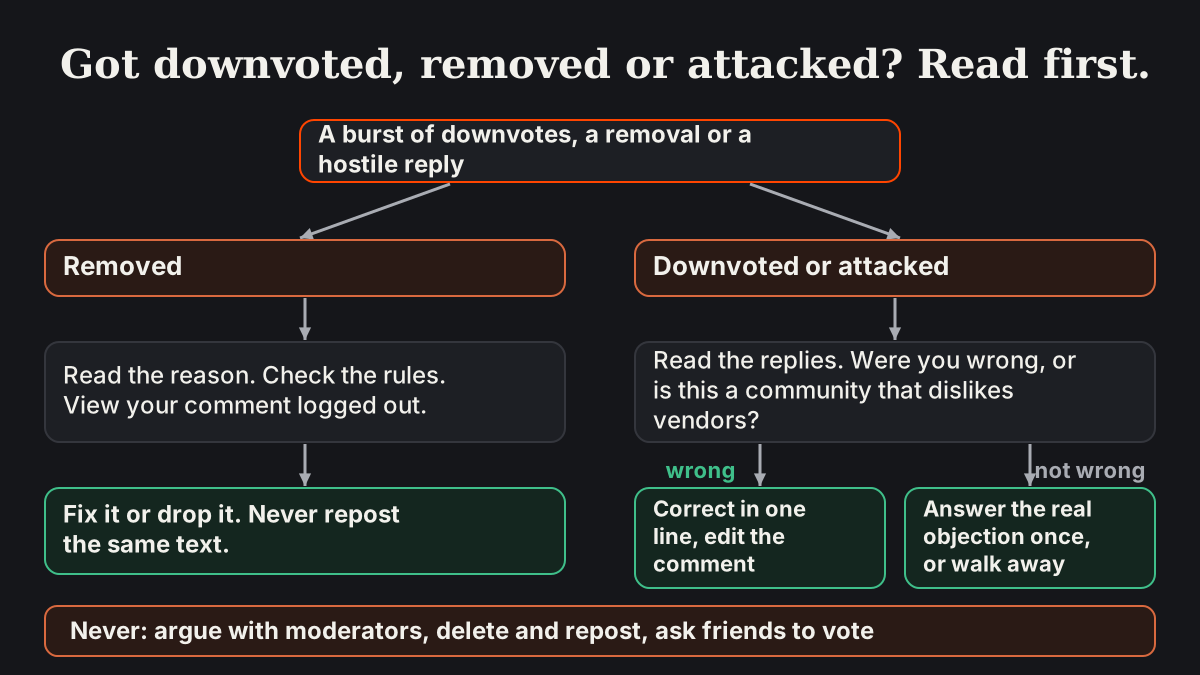
A few downvotes are normal and tell you nothing. A burst of downvotes with replies is a signal, so read the replies before deciding what it means. Common causes:
- The answer was wrong or incomplete. Fix it.
- The tone read as sales. Remove the pitch and say more about the problem.
- You are a vendor in a community that dislikes vendors. Nothing you write will fix this, so walk away.
- You were late and the point had already been made.
Responding
- Correct, do not defend. If someone is right, say so in one line and edit the comment with the fix.
- Answer the question behind the hostility. It is often a real objection ("you have a conflict of interest"). Agree that it exists and restate the limit.
- Do not argue with moderators or the thread's regulars. You will not win, and the thread will be screenshotted.
- Never delete and repost. Posting the same comment again after a removal looks like evasion. In an r/ShadowBan thread about a 12-year-old account, a helper found the same comment posted seven times in two minutes and called it "a huge red flag" (thread).
Our template for replying to a challenge is Template 3 in the writing section.
Removals
If a comment disappears, find out whether it was removed or filtered: view your profile logged out, or open the thread in a private window. If you cannot see it there, a filter or the moderators took it down. Read the removal message if there is one, check the rules again and do not repost. If you suspect a site-wide problem, see how to check for a shadowban and fix it.
A negative post about your brand that ranks in Google is a separate problem. Reply calmly, say who you are and address the facts. See what to do when a negative thread ranks for your brand.
Working with moderators
Moderators are volunteers who care about one community. Treat them like the landlords of a space you're visiting.
- Read the rules, wiki and pinned posts before every new type of post.
- Use modmail to ask before a brand post, an AMA, a poll or an announcement. Say who you are, what you plan to post, and that you're happy to change it or skip it.
- Take removals quietly. Fix the problem or move on.
- Never ask a moderator to approve something that breaks the rules.
- Don't try to get a moderator removed, and don't try to get around a ban. Evading a ban with another account is against Reddit's rules.
Reddit lets brands run their own communities too. See how to create a subreddit for your brand.
Scaling with a team
Once one person's routine works, you can add people. The risk is that quality drops and the rules slip. Four habits keep that from happening.
Give each account to one named person who knows the subject. Do not share logins. Each person answers questions in their own area.
Assign roles, even if they are part time.
| Role | Does | Does not |
|---|---|---|
| Operator | Finds threads, drafts and posts replies from their own account | Posts anything they would not say in person |
| Reviewer | Reads drafts for rule fit, claims and disclosure before posting | Rewrites into marketing language |
| Analyst | Keeps the log, runs the monthly checks, reports | Chooses threads for the operator |
| Owner | Decides goals, communities and what is off limits | Overrules a moderator |
Write a short style guide: plain words, no em-dashes or corporate phrases, one disclosure line, a banned-claims list (no unverified stats, no comparisons you cannot back), and the delete test.
Run a draft-and-approve loop. Someone drafts, someone reviews, then it gets posted. Nothing goes live until a human has read the thread and the subreddit's rules. Tools that draft are fine. Tools that auto-post are a risk, which we look at in should Reddit tools auto-post.
If the volume is more than your team can handle, an agency can run it. We are a Reddit marketing agency for funded B2B SaaS, fintech and DTC brands, and this comparison lays out when each route makes sense.
Tools
You don't need many tools. Most of the work is finding threads, checking subreddit rules and accounts, and tracking what happens after you post.
| Job | Free option | Notes |
|---|---|---|
| Find communities | Subreddit finder | Treat output as a shortlist to verify by reading |
| Find threads | Thread finder, keyword alerts | Alerts show keyword matches, not intent |
| Check rules | Post rule checker | Read the live rules yourself too |
| Check an account | Account lookup | Shows karma and age |
| Draft and rank threads | Reddit monitoring app (free to start) | Drafts rule-aware replies you edit and post yourself; on Done for you we can post them through our warmed-up accounts |
For a broader comparison of alerting tools, see Reddit marketing tools. Whichever tool you pick, read every thread yourself before you reply.
Measuring what a thread is worth
Reddit attribution is imperfect, so pick a simple system you will keep up with.
The thread log
Log one row per thread you took part in:
| Field | Example |
|---|---|
| Thread URL and date | link, date posted |
| Subreddit | community name |
| Ranks in search? | yes/no, for which query |
| Your comment link | link |
| Engagement | upvotes, replies in 7 days |
| Off-Reddit signal | DM, email, site visit, signup, demo |
| Outcome level | 0 to 4 (below) |
| Time spent | minutes |
Four outcome levels
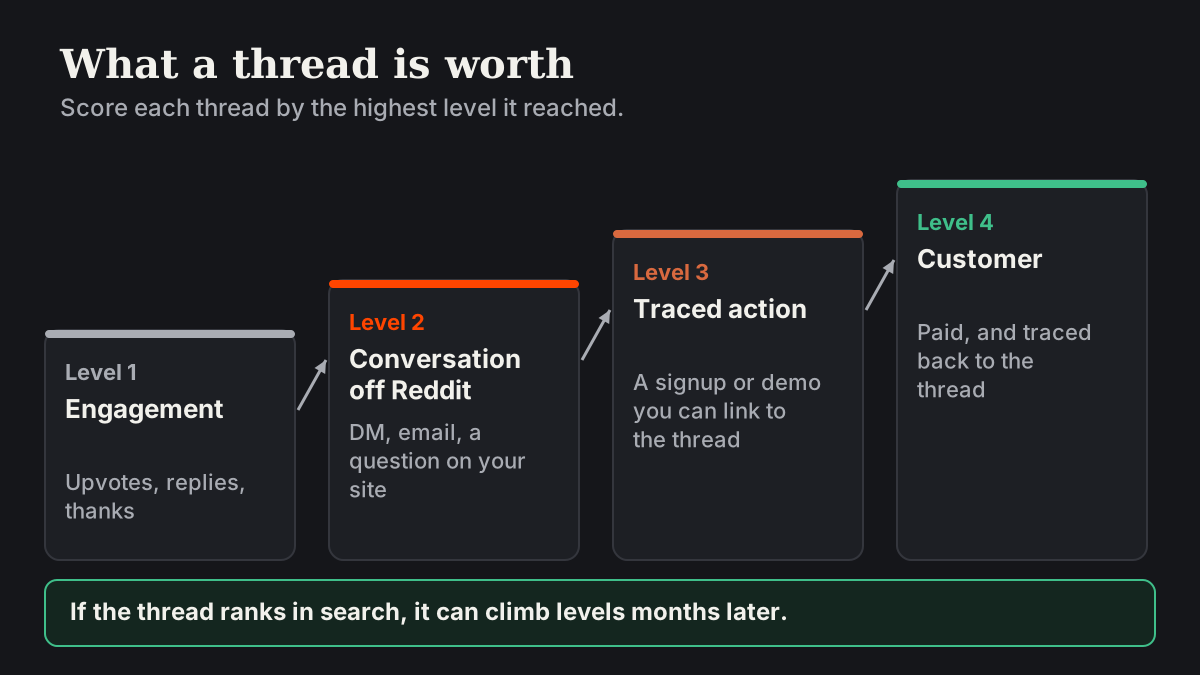
- Level 0: nothing visible.
- Level 1, engagement: upvotes, replies, thanks.
- Level 2, conversation off Reddit: a DM, an email, a question on your site.
- Level 3, traced action: a signup or demo request you can link to the thread.
- Level 4, customer: someone who paid and can be traced back.
Score each thread by the highest level it reached, and note whether it ranks in search, since a ranking thread can climb levels months later. Divide by time spent and you'll see which kinds of thread are worth chasing. We don't give benchmark numbers because none are reliable. The log exists so you learn your own.
Attribution without false precision
- Use tracked links where they're allowed. Many communities remove links or ban them for new accounts, so tracked links only catch part of the traffic.
- Put an open "how did you hear about us?" field on signup and demo forms. Make it free text, not a dropdown, because people don't remember Reddit as a channel.
- Watch branded search in Search Console. Brand clicks rising after weeks of steady participation is a typical trace of dark demand.
- Check referral visits from reddit.com in your analytics.
- Run AI-answer checks. Keep a fixed list of 10 to 30 buyer questions, run them monthly in the AI tools your buyers use, more than once each, and record whether you're named, cited or recommended. This has been unstable: Promptwatch, a vendor, reported Reddit's share of ChatGPT citations fell from a 3.83% average to under 1% in mid-August 2026, and called the size of the drop provisional. See the GEO playbook and does ChatGPT cite Reddit.
Views don't count as a result. One founder wrote up a week of Reddit-only marketing under the title "60K views, 80 visitors, 7 signups, $0 revenue". Track what happens after the view.
A worked example, from zero to a customer-quality thread
This walk-through uses a made-up product so we can show decisions without claiming results. ShiftSimple is a hypothetical staff-scheduling tool for small restaurants, and its founder, Dana, has never used Reddit for work. None of this is a real case, and no numbers are implied.
On day 1, Dana sets a goal and a metric. The goal is to win buying-intent threads. The metric is how many conversations (DMs or emails) start from a thread each month. Listening is the secondary job.
Days 2 to 7 go to research. She searches Reddit and site:reddit.com for "restaurant scheduling app" and two competitor names, reads the rules and the last month of threads in four candidate communities, scores them, and keeps three. She notes that one bans all links and another pushes promotion into a weekly thread.
Weeks 1 to 4 are warm-up. Dana posts from her own account, with a bio that says she runs ShiftSimple. She answers questions about scheduling and labor planning from her own experience and never mentions the product. She keeps a short log of which answers got replies. A typical comment:
If your team's availability changes weekly, a single master schedule will break. What worked for me was a two-week rolling template with a hard cutoff for swap requests on Wednesday. It stopped the Sunday texts. The catch is that it needs one person to own it, so it won't fix a place with no manager on shift.
In week 5 the first qualifying thread shows up. A post in the owners' community reads: "What do you use to schedule staff? Spreadsheet is killing me." Dana runs the five questions from the strategy page. She can answer it. The thread is fresh and active. The rules allow a mention when someone asks for options, and the poster did ask for tools. Her comment would stand on its own without the product. She writes:
I've used a shared spreadsheet, a free scheduling app and our own tool. The spreadsheet works until you have swap requests. The free app was fine for a small team but got clunky with split shifts. Full disclosure, I run ShiftSimple, which is aimed at places with three to twenty staff and mostly handles swaps and availability. It's weaker on payroll, so if that's your main pain, check [name another type of tool] first. Happy to answer questions about any of it.
Then she stays on the thread for a couple of days and answers follow-ups with specifics.
Week 6 brings the outcome. Someone replies with a question about swaps, then sends a DM asking for a demo. Dana offers a short call and logs the thread at level 2. If that person signs up, it moves to level 3, and if they pay, level 4. If nobody does, the log still shows what kind of thread produced a conversation, and she goes looking for more like it.
Upvotes aren't what make this a "customer-quality" thread. The person asking matched her ideal customer, the comment helped them whether or not they bought, and they started the conversation that followed. Write down your own version of that before you begin, so you can tell attention apart from fit.
In week 12 Dana reviews the log. Threads asking for a tool recommendation produced conversations and general complaints produced only upvotes, so she narrows her search to recommendation threads and drops the community where nothing got a reply.
Troubleshooting table
| Symptom | Likely cause | Fix |
|---|---|---|
| Comments get no replies or votes | Wrong or late thread; generic answer | Choose fresher or ranking threads; add one specific detail; answer sooner |
| Comment disappears, no message | AutoModerator filter on age or karma; a link | Check age and karma with the account lookup; remove the link; ask the mods |
| You see your comment, others cannot | Filter or site-level spam action | View logged out; read the shadowban guide; stop posting until resolved |
| Post removed as self-promotion | Rule or ratio breach; mention too early | Rework to value first; check flair and weekly thread; read the rules again |
| Heavy downvotes | Tone, promo, or wrong audience | Read the replies; correct or walk away; no arguing |
| Banned from a community | Repeated breaches or one clear rule violation | Send one polite modmail appeal; do not use another account to return |
| Traffic but no signups | Wrong audience, or no clear next step | Re-score communities; offer a concrete, honest next step in thread |
| No attribution | Dark demand | Add the open "how did you hear" field; watch branded search |
| AI tools do not name you | Engine does not cite Reddit for your questions, or no accurate threads exist | Check which engines cite Reddit for your questions; improve accurate discussion; do not seed posts |
The master checklist
Before you start:
- Write down one goal and one metric.
- Pick three to five communities by score and save their rules.
- Use a named person's account with an honest bio, and check its age and karma.
- Have the thread log, the AI-question set and the "how did you hear" field ready.
Before each reply:
- I can answer this properly.
- I read this community's rules today.
- The comment still stands if you delete the product from it.
- If I mention the product, I say I work on it and name a limit.
Every month:
- Re-score communities and drop the dead ones.
- Review the log by outcome level and thread type.
- Re-run the AI-answer questions.
- Add whatever moderators removed to the style guide.
FAQ
How long should I wait before mentioning my product?
Reddit doesn't set a number, so it's a judgment call. We suggest about four weeks of helpful answers without a mention. After that, mention it only in threads asking for options, and only in communities whose rules allow it. Some communities have their own account-age and karma gates, so check those first.
Can I use AI to write my Reddit comments?
Use it for drafts, but don't post what it writes unedited. Members can tell generic text when they see it, and some communities have rules against AI-generated posts. Rewrite it in your own words, add facts only you know, and read the thread before you post.
What do I do if a comment gets removed?
Read the removal reason if there is one, then check the rules again. Don't repost the same text. If it keeps happening, look for an account-age or karma gate, a link restriction, or a wider filter on your account.
How do I know whether Reddit is working?
Keep a thread log with four outcome levels, and track branded search, referral visits and an open "how did you hear about us" field alongside it. Review it monthly. Most of the effect will be indirect, so judge it over at least one 90-day cycle.
Should I use a brand account or my own?
A named person with the affiliation disclosed is safer for posting in other communities. Keep the brand account for announcements and your own subreddit. Don't run an account that pretends to be an ordinary customer.
Is it worth hiring an agency?
It can be, if you don't have the time to find threads and answer them well, or you lack expertise in a regulated area. Look for one that discloses its method, refuses fake accounts and bought upvotes, and doesn't promise AI citations. Our own approach is on the agency page.
Next steps
Pick your goal, score your communities and start the thread log this week. Start with the free thread finder. The Reddit monitoring app drafts rule-aware replies. You post them yourself, or have us post them on the Done for you plan. If you'd rather have specialists run it, talk to us. The rest of the guides are on the Learn hub, including the vertical playbooks for SaaS, startups and B2B.